scrivio

Writing, speaking and being understood

Scrivio teaches children to say what they mean, clearly, in writing and out loud, in one language or two. Short lessons, real readers, and feedback on everything they write.

The starting-point check and its results are free, with no card.

Scrivio
$29 a month for the first child, $19 for each sibling
Essentials (Numerio + Scrivio)
$49 a month for the first child, $19 for each sibling
The whole academy (Numerio + Scrivio + Inventio)
$79 a month for the first child, $19 for each sibling

What school doesn't teach

Grammar and spelling stay the foundation. On top of it, Scrivio teaches the communication adults wish they had learned early, in every school year.

Keep both languages growing

Many families speak one language at home and another at school, and in writing the second one quietly falls behind. Scrivio runs two courses side by side, each written natively for its own language.

Knowledge is built.

One idea, one connection, one step at a time. Scrivio keeps a map of every skill and what it rests on, and builds each child’s path across it.

  1. 1

    Find the starting point

    A short check marks on the map what your child already knows, so practice starts right at the edge of it.

  2. 2

    Make each skill solid

    A short lesson, then practice until the skill holds. A mistake brings a little more practice.

  3. 3

    Keep everything alive

    Learned skills come back at growing intervals, just before they would fade, and each review also refreshes the skills underneath.

See exactly how they're doing

The parent area, behind your password, shows progress in every part of the course and the day-by-day effort.

  • Everything they write, with the feedback they got
  • The weak spots they're working on
  • XP for each day of the week (about 1 XP per minute of focused work)
  • Emails when something worth knowing happens: a finished project, a big step forward, a few days off, or pasted text

The courses

Children ages 8 to 14 who can type a little, with one course for each school year, from Grade 3 to Grade 8.

ages 8–14 · 787 topics · 0 writing projects

Scrivio

Un percorso per ogni anno di scuola, dalla prima frase chiara al testo argomentativo, su testi veri e curiosi. Impara a esprimerti.

  • 3ª primaria Ages 8–9 · 132 topics
  • 4ª primaria Ages 9–10 · 126 topics
  • 5ª primaria Ages 10–11 · 139 topics
  • 1ª media Ages 11–12 · 131 topics
  • 2ª media Ages 12–13 · 128 topics
  • 3ª media Ages 13–14 · 131 topics
  • Lettura e comprensione 205 topics

    Che cosa ci dice il titolo? · Chi c'è e che cosa fa? · Dove e quando succede? · Perché è successo? …

  • Lessico 78 topics

    La spiegazione è lì vicino · Gli esempi ti aiutano · Prova e controlla · Famiglie di parole …

  • Scrittura 180 topics

    Dove succede? Aggiungi il luogo · Quando succede? Aggiungi il tempo · Come succede? Aggiungi il modo · Prima, poi, alla fine …

  • Argomentare 78 topics

    Fatto o opinione? · Secondo me, penso che, il migliore · Dillo chiaro: che cosa pensi? · Secondo me… perché… …

  • Grammatica 36 topics

    Ogni cosa ha un nome · Lo zaino, gli zaini · Com'è? L'aggettivo che descrive · Il verbo: che cosa succede? …

  • Ortografia e punteggiatura 79 topics

    Cane o cena? La c che cambia suono · Una h per indurire: che, chi, ghe, ghi · La maiuscola apre la frase · Il punto: qui la frase finisce …

  • Scrivere chiaro 58 topics

    Che cosa voglio dire? Il punto in una frase · Chi legge non c'era · Rileggi ad alta voce · Spiegare con i fatti …

  • Scrivere per pensare 18 topics

    Scrivere per capire · Prima di scrivere: raccogli le idee · Prendere appunti mentre leggi · Raggruppare le idee simili …

  • Parlare e presentare 21 topics

    Presentarsi in tre frasi · Mostra e racconta · Un discorso, un messaggio · Come finire un discorso …

  • Ascoltare e parlarsi 22 topics

    Domande aperte e domande chiuse · Grazie, e ti dico perché · Un complimento preciso · Ciao o Gentile? Pensa a chi legge …

  • Tra due lingue 12 topics

    In che lingua scrivo? · Parole senza traduzione · Spiegare un modo di dire in un'altra lingua · Fare da ponte tra due lingue …

ages 8–14 · 784 topics · 0 writing projects

Scrivio

Un camino para cada curso escolar, de la primera oración clara al texto argumentativo, con textos reales y curiosos. Aprende a expresarte.

  • 3.º de primaria Ages 8–9 · 129 topics
  • 4.º de primaria Ages 9–10 · 128 topics
  • 5.º de primaria Ages 10–11 · 139 topics
  • 6.º de primaria Ages 11–12 · 128 topics
  • 1.º de ESO Ages 12–13 · 130 topics
  • 2.º de ESO Ages 13–14 · 130 topics
  • Lectura y comprensión 205 topics

    ¿Qué nos dice el título? · ¿Quién aparece y qué hace? · ¿Dónde y cuándo pasa? · ¿Por qué pasa? …

  • Vocabulario 78 topics

    La palabra explicada en la oración · Entender una palabra por los ejemplos · Prueba la palabra en la oración · Familias de palabras …

  • Escritura 180 topics

    ¿Dónde pasa? Añade el lugar · ¿Cuándo pasa? Añade el tiempo · ¿Cómo pasa? Añade la manera · Primero, después, al final …

  • Argumentar 78 topics

    ¿Hecho u opinión? · Para mí, creo que, el mejor · Dilo claro: ¿qué piensas? · Para mí… porque… …

  • Gramática 41 topics

    Palabras que nombran: el sustantivo · Palabras que dicen cómo es: el adjetivo · Palabras que dicen qué pasa: el verbo · Sin saltos de tiempo …

  • Ortografía y puntuación 71 topics

    Mayúscula al empezar y después de punto · El punto: aquí acaba la idea · Ca, que, qui, co, cu · Ga, gue, gui, go, gu …

  • Escribir claro 58 topics

    ¿Qué quiero decir? La idea en una oración · Quien lee no estaba allí · Relee en voz alta · Explicar con datos …

  • Escribir para pensar 18 topics

    Escribir para entender · Reunir las ideas antes de escribir · Tomar notas mientras lees · Agrupar las ideas parecidas …

  • Hablar y presentar 21 topics

    Presentarte en tres oraciones · Enseña y cuenta · Una charla, un mensaje · Cómo terminar una charla …

  • Escuchar y conversar 22 topics

    Preguntas abiertas y preguntas cerradas · Gracias, y te digo por qué · Un elogio preciso · ¿Hola o Estimada? Piensa en quién lee …

  • Entre dos lenguas 12 topics

    ¿En qué lengua escribo? · Palabras sin traducción · Explicar una expresión en otra lengua · Hacer de puente entre dos lenguas …

ages 8–14 · 773 topics · 0 writing projects

Scrivio

A path for every school year, from the first clear sentence to a well-argued essay, practiced on real and surprising texts. Learn to say what you mean.

  • Grade 3 / Year 4 Ages 8–9 · 131 topics
  • Grade 4 / Year 5 Ages 9–10 · 130 topics
  • Grade 5 / Year 6 Ages 10–11 · 131 topics
  • Grade 6 / Year 7 Ages 11–12 · 129 topics
  • Grade 7 / Year 8 Ages 12–13 · 125 topics
  • Grade 8 / Year 9 Ages 13–14 · 127 topics
  • Reading 205 topics

    What does the title tell you? · Who is it about, and what do they do? · Where and when does it happen? · Why did it happen? …

  • Vocabulary 78 topics

    The meaning is right next to it · Examples help you · Try it and check · Word families …

  • Writing 180 topics

    Where does it happen? Add the place · When does it happen? Add the time · How does it happen? Add the way · First, then, finally …

  • Argumentation 78 topics

    Fact or opinion? · In my opinion, I think, the best · Say it clearly: what do you think? · I think… because… …

  • Grammar 40 topics

    Nouns: words that name the world · A sentence needs a who and a what · Verbs: what's happening? · A, an or the? …

  • Spelling and punctuation 61 topics

    Capital to start, period to stop · Question mark or exclamation mark? · One fox, two foxes · Commas between list items …

  • Clear writing 58 topics

    What do I want to say? Your point in one sentence · Your reader wasn't there · Read it out loud · Explaining with facts …

  • Writing to think 18 topics

    Write it to understand it · Before you write: gather your ideas · Taking notes while you read · Sorting your notes into groups …

  • Speaking and presenting 21 topics

    Introduce yourself in three sentences · Show and tell · One talk, one message · How to end a talk …

  • Listening and conversation 22 topics

    Open questions and closed questions · Thank you, and here's why · A compliment with a detail · Hi there or Dear? Think of your reader …

  • Between two languages 12 topics

    Which language do I write in? · Words with no translation · Explaining an idiom from another language · Be the bridge between two languages …

Teaching our own children, we kept asking what they really need to learn. The answer stayed simple: to reason, to express themselves and to create.

Since 2019 we have traveled full time as a family, and our two children have learned with us along the way. With AI, these skills matter even more. So we built io.academy: one academy with three schools, one for each.

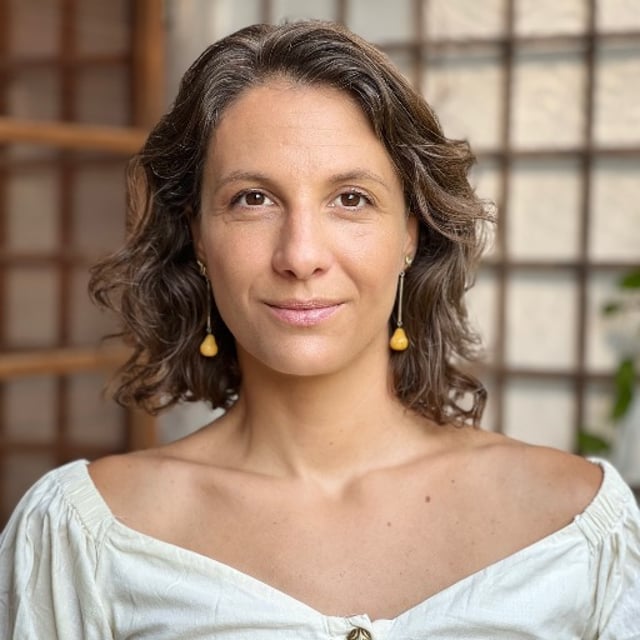
Carlotta Cerri & Alex BendikenParents, and the founders of io.academy Read our story →

Simple pricing

One subscription for the family, priced per child. All three languages and every level are included.

  • Every school year, in English, Italian or Spanish

30-day money-back guarantee. If Scrivio isn't right for your family in the first 30 days, write to hello@io.academy and we'll refund your payment.

Your plan

Taxes included. Cancel any time; 30-day money-back guarantee.

Questions parents ask

All questions →

How does it teach?

Grammar is taught through what words do in a sentence and how that makes writing better. Writing tasks have a real reader: a message to a museum, a fact file for a younger cousin. Every child moves at their own pace: each skill is practised until it's solid, and what they already know is skipped.

How early can we start?

From about 8, once your child can read on their own and type a few words a minute, up to 14. Choose your child's school year: the starting check begins there and fills gaps from earlier years.

How long each day?

About 20 to 30 minutes. You set a daily goal in XP; one XP is roughly one minute of focused work, so the default goal of 30 XP is about half an hour. Fast guessing doesn't earn XP. Each school has its own daily goal.

How do the languages work?

Courses are in English, Italian and Spanish, and each child can follow one or two. With two, you choose a main and a second language and a rhythm: alternating days, or more days in the main language. Scrivio picks one language each day, so your child never has to decide. If one language has a pile of reviews waiting, it gets the next day.

How does it help them learn faster?

Three things do most of the work: starting at the right level, moving on only once a skill is solid, and reviewing it just before it would be forgotten. Reviews also count for the skills underneath, so practice adds up.

Is it really AI?

Partly, and only where it helps. An AI model checks the writing your child does: it answers the yes-or-no questions attached to each writing task, and points out which skill a mistake belongs to, so a refresher can come up later.

Everything else is not AI: the lessons, exercises and reading texts are prepared in advance and are the same for everyone, most exercises are marked by simple rules, and what comes next follows fixed rules about mastery and reviews.